

Amazon Layoffs 2025: 14,000 Jobs Cut as AI Reshapes Workforce


The email arrived on Tuesday morning, October 28, 2025. For approximately 14,000 Amazon corporate employees, it delivered life-altering news: their positions were being eliminated. This marks the largest workforce reduction in Amazon’s history since the company cut 27,000 jobs between late 2022 and early 2023.
While initial reports suggested the layoffs could affect up to 30,000 positions, Amazon officially confirmed 14,000 corporate job cuts—representing about 4% of its roughly 350,000 corporate workforce. The announcement came through an internal memo from Beth Galetti, Amazon’s Senior Vice President of People Experience and Technology, who framed the reductions as necessary to “reduce bureaucracy, remove layers” and invest in Amazon’s “biggest bets,” particularly generative artificial intelligence.
For affected employees, most will receive 90 days to search for new roles internally before facing severance. For the broader tech industry, these Amazon layoffs signal a fundamental shift: major corporations are rapidly discovering that AI can replace significant portions of their corporate workforces faster than anyone anticipated.
This isn’t just about Amazon trimming excess staff hired during pandemic boom years. This represents the beginning of a structural transformation where artificial intelligence fundamentally alters what corporate work looks like, who does it, and how many people companies actually need.
The Scale and Scope of Amazon Layoffs 2025
Official Numbers vs. Reported Figures
Amazon officially announced 14,000 corporate job cuts beginning October 28, 2025. However, multiple credible news organizations—including Reuters, CNBC, and The Guardian—reported that internal sources indicated the actual number could reach 30,000 positions over an extended period.
The discrepancy matters. If the higher figure proves accurate, these Amazon layoffs would eliminate nearly 10% of the company’s entire 350,000 corporate workforce. That would make this the most dramatic corporate workforce reduction in Amazon’s 30-year history, dwarfing even the 27,000 positions cut during the 2022-2023 downsizing.
As of December 2024, Amazon employed approximately 1.56 million people globally. Corporate and technology workers comprise roughly 350,000 of that total, with the remaining 1.2+ million working in warehouses, fulfillment centers, and delivery operations. These layoffs target exclusively corporate roles—not the warehouse workforce that Amazon is actually expanding for holiday season demand.
Which Divisions Are Being Hit
The Amazon job cuts span virtually every major corporate division:
Human Resources (People Experience and Technology – PXT): Amazon’s HR division faces cuts potentially reaching 15% of its 10,000+ employee workforce. This department handles recruiting, employee relations, benefits, and workplace culture initiatives.
Amazon Web Services (AWS): The cloud computing division that generates the majority of Amazon’s profits is experiencing layoffs despite strong revenue growth. AWS remains Amazon’s most profitable business segment but isn’t immune to the cost-cutting mandate.
Devices and Services: The division responsible for Alexa, Echo devices, Fire tablets, and Kindle e-readers faces workforce reductions. This unit has struggled with profitability for years despite strong product recognition.
Operations: Teams managing logistics, fulfillment strategy, and supply chain optimization are seeing job cuts. This represents a shift from Amazon’s historic pattern of protecting operations staff.
Amazon India: The company’s critical Indian market faces layoffs of 900-1,100 employees as part of the global restructuring. This comes despite Amazon’s recent ₹2,000 crore investment in India’s logistics infrastructure.
Timeline and Implementation
Managers of affected teams received training on Monday, October 27, 2025, preparing them to deliver difficult news to their staff. Email notifications began going out Tuesday morning, October 28.
Most impacted employees receive 90 days to search for new roles within Amazon before their positions officially end. During this period, Amazon’s recruiting teams will prioritize internal candidates to help as many people as possible transition to different roles within the company.
For those unable to find new positions internally—or who choose not to pursue them—Amazon is offering severance packages, outplacement services, health insurance continuation, and other transition benefits. The specifics vary based on tenure, role, and local employment laws.
The Real Reason Behind Amazon Layoffs: It’s About AI, Not Just Cost-Cutting
Andy Jassy’s AI-Driven Vision
CEO Andy Jassy hasn’t been subtle about artificial intelligence’s role in reducing Amazon’s workforce. In a June 2025 memo to employees, he explicitly stated: “As we deploy more Generative AI and agents, it will change the way we work. We’ll need fewer people doing some of the jobs that are being done today, while we’ll need more people doing other kinds of jobs”.
Jassy continued with remarkable candor: “It’s hard to predict exactly how it’ll play out over time, but we expect that over the next few years, this will lead to an overall reduction in our corporate workforce as we gain efficiencies from deploying AI broadly across the organization”.
This isn’t speculative future-gazing. Amazon has been aggressively implementing AI tools across customer service, HR processes, logistics optimization, and code development throughout 2025. The company has witnessed firsthand how generative AI systems can automate tasks that previously required human corporate workers.
Beth Galetti’s October 28 memo reinforced this AI-centric rationale: “This generation of AI is the most transformative technology we’ve seen since the Internet, and it’s enabling companies to innovate much faster than ever before (in existing market segments and altogether new ones)”.
The Productivity Gains Amazon Is Actually Seeing
Industry analysts believe these Amazon layoffs confirm that the company is achieving measurable AI-driven productivity improvements that justify substantial workforce reductions.
Sky Canaves, an eMarketer analyst, told Reuters: “This latest move signals that Amazon is likely realizing enough AI-driven productivity gains within corporate teams to support a substantial reduction in force”. She added that “Amazon has also been under pressure in the short term to offset long-term investments in building out its AI infrastructure”.
Amazon is spending upwards of $100 billion this year in capital expenditures, primarily building cloud and AI datacenters. These massive infrastructure investments create enormous pressure to demonstrate ROI—and replacing human workers with AI systems provides concrete, measurable cost savings that offset those investments.
The company has deployed AI across multiple corporate functions:
- Customer Service: AI chatbots and automated response systems handle queries that previously required human representatives
- HR Processes: Generative AI assists with recruiting, onboarding, benefits administration, and employee communications
- Code Development: AI tools help software engineers write, test, and debug code more efficiently
- Logistics Optimization: Machine learning systems optimize warehouse operations, delivery routes, and inventory management
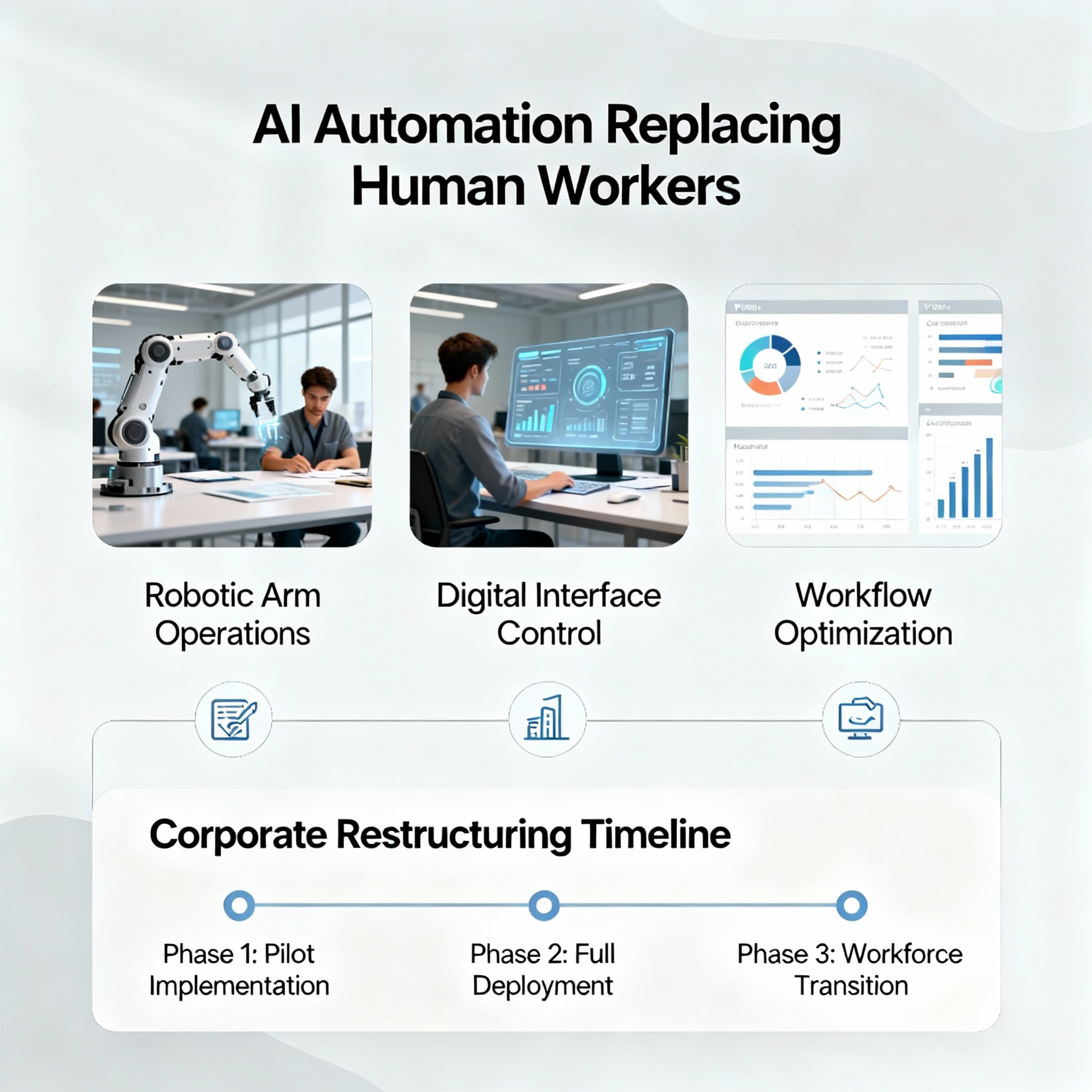
- According to The New York Times, Amazon’s internal documents suggest robotic automation could eliminate the need for up to 600,000 future hires. While Amazon disputed that specific figure, the company didn’t deny the broader trend toward automation replacing human workers.
The Bureaucracy Reduction Initiative
Jassy has simultaneously pursued what he calls a “bureaucracy reduction” campaign aimed at streamlining Amazon’s corporate structure.
In September 2024, he launched the “Bureaucracy Mailbox”—an anonymous system allowing employees to report unnecessary red tape, excessive procedures, or inefficient processes. This initiative has generated approximately 1,500 submissions, leading to over 450 process changes.
Jassy also instructed Amazon’s senior leadership teams to increase their employee-to-manager ratio by 15% by the end of Q1 2025. This translates to fewer managers overseeing larger teams—a structural shift that inherently requires workforce reduction at the management level.
The combination of AI automation and management layer reduction creates a dual force driving these massive Amazon job cuts. It’s not just about replacing workers with technology; it’s about fundamentally restructuring how Amazon’s corporate organization operates.
Employee Reactions and Corporate Culture Impact
The Human Cost of Automation
For the 14,000 (or potentially 30,000) employees losing their jobs, the Amazon layoffs represent personal and professional devastation. Social media reactions have been swift and harsh.
Spencer Hakimian, founder of Tolou Capital Management, bluntly stated on X (formerly Twitter): “AI is destroying the economy”. His sentiment echoed across social platforms as news of the amazon layoffs spread.
Reddit’s r/Layoffs community filled with discussions about Amazon’s reputation as a difficult workplace characterized by intense pressure, performance improvement plans (PIPs), and now massive layoffs. One user noted: “Employees at Amazon are often aware that it isn’t the ideal environment for long-term career development. The company has garnered a negative image due to its high-pressure work culture”.
Another commenter added: “The environment there is incredibly intense. I have a few friends working in that place who earn impressive salaries, but the pressure is immense and the competition is fierce. It feels like you’re constantly on the brink of being laid off”.
Social media users drew dark comparisons, with one stating: “A hint of great depression of 1929”. The scale and timing of the layoffs—just before the critical holiday shopping season—intensified the emotional impact for affected workers and observers.
Amazon’s Long-Term Talent Problem
Multiple industry observers question whether Amazon’s aggressive cost-cutting and notorious workplace culture will create long-term talent acquisition problems.
One Reddit user predicted: “Should the job market turn around, I suspect Amazon may come to regret its notorious reputation for high turnover. They might find it challenging to attract quality talent unless they offer exorbitant salaries”.
The pattern is already visible: many Amazon corporate employees view their tenure as resume-building rather than career-building. “Many individuals tend to endure their positions for about 2 to 2.5 years before moving on, especially since having Amazon on their resume can open doors elsewhere,” one commenter noted.
This creates a vicious cycle. High-turnover culture drives away experienced talent. Constant restructuring and layoffs destroy institutional knowledge. Remaining employees operate under perpetual stress, knowing they could be next. The resulting workplace culture makes it harder to attract top talent without paying premium compensation—which undermines the cost-cutting rationale driving layoffs in the first place.
The Return-to-Office Policy Failure
These Amazon layoffs come months after Amazon implemented a strict five-day return-to-office mandate. Many observers believed the harsh RTO policy was partly designed to drive voluntary attrition—encouraging workers to quit rather than face termination.
That strategy apparently failed. According to Reuters sources, “the company’s strict five-day return-to-office policy has failed to generate sufficient voluntary attrition, contributing to the layoff’s scope”.
In other words, Amazon hoped employees would quit rather than return to offices full-time. When that didn’t happen in sufficient numbers, the company resorted to mass amazon layoffs to achieve desired headcount reductions.
This sequence reveals a troubling corporate strategy: using workplace policy as a blunt instrument to reduce headcount, then resorting to mass firings when employees refuse to voluntarily leave.
Industry Context: Amazon Layoffs Within the Broader Tech Downturn
2025 Tech Layoffs Surge
Amazon’s workforce reduction isn’t happening in isolation. According to Layoffs.fyi, 98,000 tech jobs were lost across 216 firms in 2025 so far. This represents a significant escalation from the 153,000 positions eliminated throughout all of 2024.
Major tech companies implementing significant workforce reductions in 2025 include:
- Meta (Facebook): Cut 600 jobs amid AI expansion push, with automation explicitly replacing human staff
- Target: Eliminated 1,000 jobs and hundreds of open roles
- Google: Continued selective layoffs across various divisions
The pattern is consistent across the industry: companies are simultaneously investing billions in AI infrastructure while eliminating human workers whose roles can be automated.
The AI Replacement Acceleration
What’s different about 2025’s layoffs compared to previous years? The explicit acknowledgment that AI is directly replacing human workers—not just “optimizing efficiency” or “streamlining operations”.
Andy Jassy told CNBC in June: “As with every technological evolution, some jobs will see a reduction in personnel due to automation”. This represents a marked shift from corporate euphemisms. Leaders are now openly stating that AI systems are replacing human workers, and they expect this trend to accelerate.
Corporations are increasingly using AI to write code for software, adopting AI agents to automate routine tasks, and deploying generative AI for customer service, HR functions, and administrative work. The technology has progressed from experimental to production-ready across multiple corporate functions.
The Financial Pressure for AI ROI
Amazon and other tech giants face intense investor pressure to demonstrate return on investment for massive AI spending.
Amazon is spending over $100 billion in 2025 on AI and cloud infrastructure. Microsoft, Google, and Meta have similar capital expenditure levels. Shareholders want to see these investments translate to either revenue growth or cost savings.
Since AI revenue remains uncertain—most generative AI products haven’t yet proven sustainable business models—companies are focusing on the cost-savings equation. Replacing expensive human workers with AI systems provides concrete, immediate ROI that justifies infrastructure spending.
This creates a self-reinforcing cycle: invest in AI → need to show ROI → replace workers with AI → achieve cost savings → justify more AI investment → replace more workers.
What This Means for Amazon’s Future and the Broader Economy
Amazon’s Strategic Positioning
Despite the massive Amazon layoffs, the company maintains it will continue hiring in “key strategic areas”. The memo specifically noted that Amazon expects to keep hiring even as it reduces overall headcount.
This apparent contradiction makes sense in context. Amazon is shifting its workforce composition from routine corporate roles (which AI can handle) toward specialized positions focused on AI development, advanced engineering, and strategic business functions (which currently require human expertise).
Amazon also continues expanding its warehouse and delivery workforce. The company is hiring 250,000 seasonal workers for the holiday season—a stark contrast to the corporate layoffs. Physical logistics automation is progressing more slowly than corporate function automation, leaving warehouse roles temporarily safe.
The Precedent for Other Companies
Amazon’s explicit acknowledgment that AI is driving workforce reductions sets a powerful precedent for other companies.
If the world’s second-largest private employer can cut 14,000-30,000 corporate positions while attributing reductions directly to AI capabilities, other corporations will feel emboldened to pursue similar strategies.
Neil Saunders, GlobalData Managing Director, stated: “The Amazon layoffs are dramatic in scale, and they represent a deep cleaning of Amazon’s corporate workforce… While Amazon could never be described as a flabby organisation, it has become more complex and layered over time and there is scope for some simplification”.
This “deep cleaning” metaphor will likely be adopted by other corporations justifying their own AI-driven workforce reductions. Amazon’s actions normalize mass layoffs framed as necessary modernization rather than cost-cutting or failure.
The Broader Economic Implications
The Amazon layoffs raise fundamental questions about economic structure in an AI-driven future:
Job displacement vs. job creation: While AI eliminates certain roles, will it create enough new positions to employ displaced workers?
Income inequality: High-skilled AI developers command premium salaries while routine corporate workers lose jobs entirely, potentially widening income gaps.
Consumer demand: If mass unemployment results from widespread AI adoption, who will have purchasing power to buy products and services?
Social stability: Rapid job displacement without adequate transition support or retraining could create significant social upheaval.
These aren’t distant theoretical concerns. They’re playing out right now, with 14,000 Amazon employees and potentially hundreds of thousands of tech workers globally facing unemployment driven explicitly by AI automation.
Frequently Asked Questions
How many Amazon employees are being laid off in 2025?
Amazon officially confirmed 14,000 corporate job cuts beginning October 28, 2025. However, multiple reports citing internal sources suggest the actual number could reach 30,000 positions over an extended period. These layoffs affect only corporate roles, not Amazon’s warehouse or delivery workforce.
Why is Amazon laying off so many employees?
Amazon attributes the layoffs to two primary factors: AI-driven productivity improvements that reduce the need for certain corporate roles, and a broader initiative to reduce bureaucracy by eliminating management layers. CEO Andy Jassy explicitly stated in June 2025 that generative AI adoption would “inevitably” reduce Amazon’s corporate workforce over the next few years.
Which Amazon divisions are affected by layoffs?
The job cuts span multiple divisions including Human Resources (People Experience and Technology), Amazon Web Services (AWS), Devices and Services, Operations, and corporate functions. The HR division may face cuts of up to 15% of its 10,000+ employee workforce.
What severance and benefits do laid-off Amazon employees receive?
Most impacted employees receive 90 days to search for new roles internally before their positions officially end. For those unable to secure new Amazon positions, the company offers severance pay, outplacement services, health insurance continuation, and other transition benefits, with specifics varying based on tenure, role, and local employment laws.
Is AI really replacing human workers at Amazon?
Yes. CEO Andy Jassy explicitly stated that generative AI deployment will reduce the need for many current corporate roles. Industry analysts believe Amazon is achieving measurable AI-driven productivity gains that justify substantial workforce reductions. The company has deployed AI across customer service, HR processes, code development, and logistics optimization.
Will Amazon layoffs affect warehouse workers?
No. The current layoffs target exclusively corporate and technology roles, not warehouse or fulfillment center workers. In fact, Amazon is hiring 250,000 seasonal warehouse workers for the holiday season, even as it cuts corporate positions.
How do these amazon layoffs compare to previous Amazon job cuts?
These are the largest layoffs in Amazon’s history. The company previously eliminated approximately 27,000 positions between late 2022 and early 2023. If reports of 30,000 total cuts prove accurate, this would represent nearly 10% of Amazon’s entire 350,000 corporate workforce.
What does this mean for the tech industry overall?
Amazon’s explicit acknowledgment that AI is driving workforce reductions sets a precedent for other companies. The tech industry has already seen 98,000 job losses across 216 firms in 2025, suggesting widespread AI-driven restructuring across the sector. Amazon’s actions normalize mass layoffs framed as necessary AI-era modernization.
Conclusion: {from sources}
The Amazon layoffs of October 2025 represent more than just another corporate restructuring. They mark a turning point where artificial intelligence transitions from efficiency tool to workforce replacement at massive scale.
When the world’s second-largest private employer eliminates 14,000 corporate positions while explicitly crediting AI automation for enabling those reductions, it sends an unmistakable signal: the age of AI-driven job displacement has arrived. This isn’t speculation about potential future impacts—it’s documented reality happening right now.
The Amazon layoffs of 2025 won’t be remembered as just another corporate restructuring. They’ll be remembered as the moment when AI-driven workforce transformation moved from hypothetical future to documented present. The only question that remains is whether society can adapt fast enough to manage the transition—or whether we’ll stumble blindly into an economic upheaval we’re desperately unprepared to handle. You May Like-
- https://www.cnbc.com/2025/10/28/amazon-layoffs-corporate-workers-ai.html
- https://www.business-standard.com/technology/tech-news/amazon-to-lay-off-30k-corporate-employees-largest-job-cut-since-2023-125102800093_1.html
- https://uk.news.yahoo.com/amazon-layoffs-target-14-000-104528960.html
- https://www.cnn.com/2025/10/28/business/amazon-layoffs